
Introduction
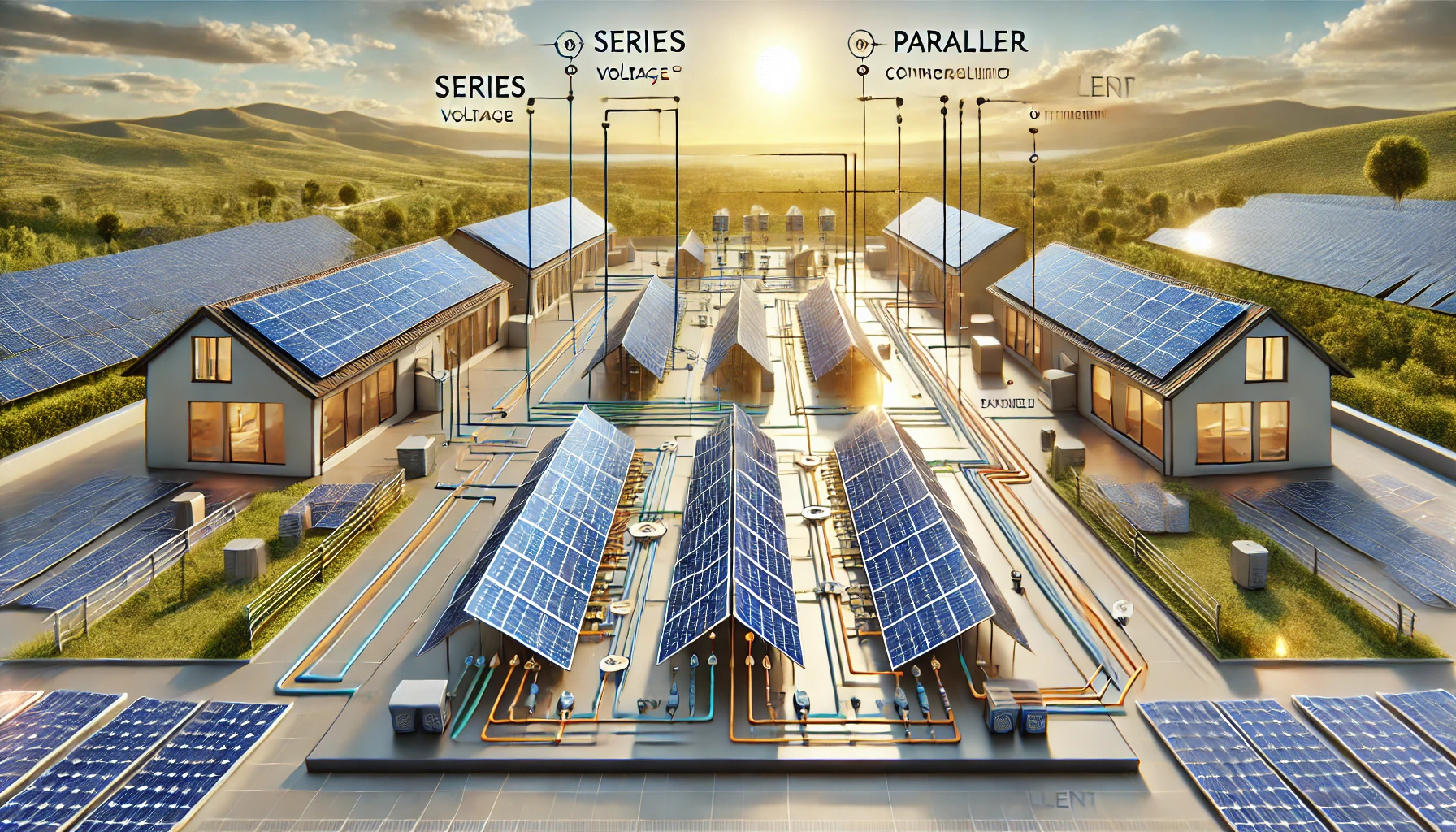
Choosing the right configuration for your solar panel system is crucial to ensure optimal performance and efficiency. When it comes to wiring and connecting multiple solar panels together, there are two main configurations: series and parallel connections. Understanding the differences between these configurations and their respective advantages and disadvantages is essential for anyone considering installing a solar power system. In this comprehensive guide, we’ll dive deep into the world of solar panel configurations, exploring the key concepts, factors to consider, and best practices for designing and maintaining your solar array.
How Solar Panels Work
Solar panels are designed to convert sunlight into usable electrical energy through a process called the photovoltaic effect. Each solar panel consists of numerous photovoltaic cells, which are made of semiconductor materials like silicon. When sunlight strikes these cells, it excites the electrons within the material, causing them to flow and generate an electric current.
The main components of a solar panel system include:
-
Solar panels: The primary component responsible for capturing sunlight and converting it into electricity.
-
Inverter: A device that converts the direct current (DC) generated by the solar panels into alternating current (AC), which is used by most household appliances.
-
Mounting hardware: The equipment used to securely attach the solar panels to a roof or other structure.
-
Wiring and connectors: The electrical components that link the solar panels to the inverter and the rest of the system.
Several factors can affect the efficiency of installing solar panels, including:
-
The quality and type of solar cells used
-
The amount of sunlight the panels receive
-
The angle and orientation of the panels
-
The temperature of the panels
-
Shading from nearby objects or debris
By understanding these factors and optimizing your solar panel configuration, you can maximize the performance and energy output of your solar power system.
Understanding Solar Panel Configurations
Key Terms
Before diving into the specifics of series and parallel connections wire solar panels, let’s define some key terms related to solar panel configurations:
-
Voltage: The measure of electrical potential difference between two points in a circuit, expressed in volts (V).
-
Current: The flow of electrical charge through a circuit, measured in amperes (A).
-
Amperage: Another term for current, often used interchangeably.
-
Output Voltage: The voltage produced by a solar panel or a string of panels connected in series.
-
Output Current: The current produced by a solar panel or a group of panels connected in parallel.
Wiring Solar Panels: Voltage and Current Considerations
When designing a solar panel system, it’s crucial to balance voltage and current to ensure optimal performance. The voltage and current output of your solar array will depend on the specific configuration you choose.
-
Voltage: In a series connection, the voltage of each panel is added together, while in a parallel connection, the voltage remains constant across all panels.
-
Current: In a parallel connection, the current output of each panel is added together, while in a series connection, the current remains constant through all panels.
The impact of different solar panel series’ voltages and currents on system performance can be significant. Mismatched panels or incorrect configurations can lead to reduced efficiency, power losses, and even damage to components. It’s essential to carefully consider your system’s voltage and current requirements when selecting and configuring your solar panels.
Series-Connected Solar Panels
In a series connection, multiple solar panels are wired together by connecting the positive terminal of one panel to the negative terminal of the next panel, forming a single string. The main characteristics of a series connection include:
-
Increased Voltage: The total voltage of the string is equal to the sum of the voltages of each individual panel. For example, if you have four 12V panels connected in series, the total voltage of the string would be 48V.
-
Constant Current: The current flowing through the string is limited to the current of the panel with the lowest rating. In other words, the current output of the entire string is equal to the current output of the weakest panel.
Series connections are ideal for grid-tied applications and low-current systems, as they allow for higher total system voltage while keeping the current relatively low. This can help reduce power losses over long distances and improve overall system efficiency.
Example: Calculating Total Voltage in Series
Let’s say you have three solar panels, each with a voltage of 24V. If you connect these solar panels in series, the total voltage of the string would be:
Total Voltage = Panel 1 Voltage + Panel 2 Voltage + Panel 3 Voltage Total Voltage = 24V + 24V + 24V Total Voltage = 72V
Parallel-Connected Solar Panels
In a parallel connection, solar panels are wired together by connecting all the positive terminals connecting solar panels together and all the negative terminals together. The main characteristics of a parallel connection include:
-
Increased Current: The total current output of the array is equal to the sum of the currents of each individual panel. For example, if you have four panels, each producing 5A of current, the total current output of the parallel array would be 20A.
-
Constant Voltage: The voltage across the array remains constant and is equal to the voltage of a single panel. In other words, all panels in a parallel connection must have the same voltage rating.
Parallel connections are ideal for off-grid and battery charging setups, as they allow for higher total current output while maintaining a constant voltage. This can be particularly useful in systems with variable light conditions or when using PWM (Pulse Width Modulation) charge controllers.
Example: Maintaining Constant Voltage in Parallel
Let’s say you have two solar panels, each with a voltage of 12V and a current output of 7A. If you connect these solar panels in parallel together, the total current output would be:
Total Current = Panel 1 Current + Panel 2 Current Total Current = 7A + 7A Total Current = 14A
The voltage across the parallel array would remain constant at 12V.
Factors to Consider When Choosing Between Series and Parallel Configurations
When deciding between series and parallel configurations for your solar panel system, there are several key factors to consider:
Voltage and Current Requirements
The first step in determining the best configuration for your solar array is to assess your solar system itself’s voltage and current requirements. This will depend on factors such as:
-
The type of inverter you plan to use (string inverter or microinverter)
-
The voltage and current ratings of your solar panels
-
The distance between your solar panels and the inverter or charge controller
-
The size and capacity of your battery bank (if applicable)
It’s essential to match your panel specifications to your system requirements to ensure optimal performance and compatibility.
Energy Production Goals
Your specific energy production goals will also influence your choice of solar panel configuration. Different applications may require different setups:
-
Grid-tied systems: Series connections are often preferred for grid-tied systems, as they allow for higher voltage and lower current, which can help reduce power losses and improve efficiency.
-
Off-grid systems: Parallel connections are typically favored for off-grid systems, as they provide higher current output and are better suited for battery charging and variable light conditions.
-
Hybrid systems: A combination of series and parallel connections may be used in hybrid systems to optimize voltage and current output for both grid-tied and off-grid applications.
Consider your energy consumption patterns, budget, and long-term goals when selecting a configuration that best meets your needs.
Available Space for Installation
The available space for your solar panel installation can also impact your choice of series or parallel solar panels configuration. Series connections typically require fewer cables and less wiring, making them a good choice for installations with limited space or complex roof layouts. Parallel connections, on the other hand, may require more cables and connectors, which can be more challenging to accommodate in tight spaces.
Panel Shading
Shading is a critical factor to consider when choosing between series and parallel configurations. In a series connection, if one panel is shaded or underperforming, it can significantly reduce the output of the entire string. This is because the current output of the string is limited to the current of the weakest panel.
In contrast, parallel connections connect solar panels are less affected by shading or panel damage, as each panel operates independently. If one panel is shaded, it will not drastically impact the performance of the other panels in the array.
If your installation site is prone to shading from nearby trees, buildings, or other obstacles, a parallel configuration may be a better choice to minimize the impact of shading on your system’s overall performance.
Charge Controller Compatibility
When designing an off-grid or hybrid solar panel system, it’s crucial to consider the compatibility of your chosen configuration with your charge controller. There are two main types of charge controllers:
-
PWM (Pulse Width Modulation): PWM charge controllers are typically less expensive and work well with parallel configurations, as they can efficiently manage the higher current output.
-
MPPT (Maximum Power Point Tracking): MPPT charge controllers are more efficient and can optimize the power output of your solar array. They work well with both series and parallel configurations but are particularly beneficial for series connections, as they can help mitigate the impact of shading or panel mismatch.
Be sure to select a charge controller that is compatible with your desired configuration and can handle the voltage and current output of your solar array.
Pros and Cons of Series and Parallel Connections
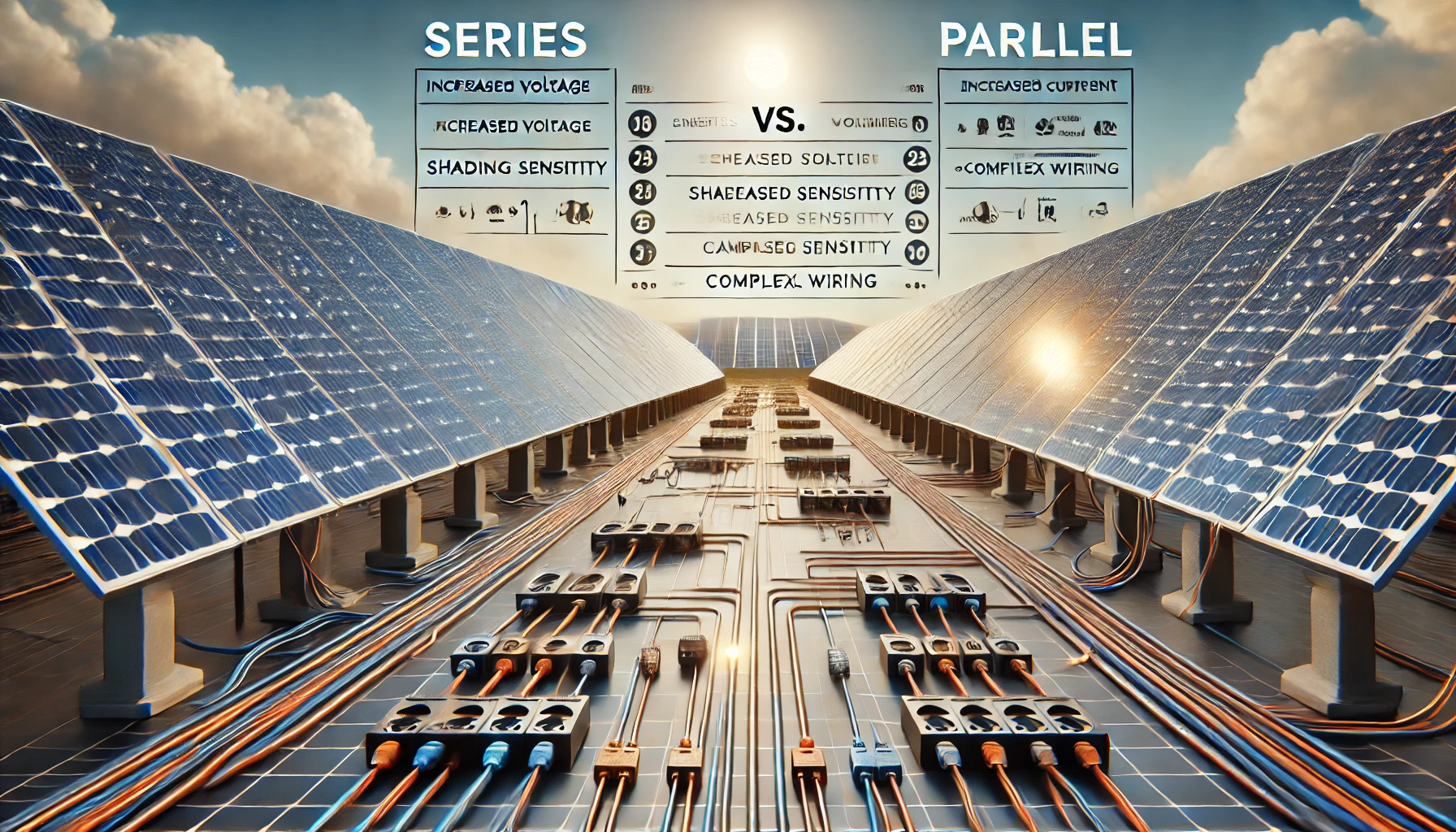
Series Wiring
Pros:
-
Higher power output due to increased voltage
-
Reduced power loss over long distances, as higher voltage results in lower current and less resistance
-
Improved efficiency in low light conditions, as the higher voltage allows the inverter to operate more effectively
-
Simplified installation with fewer cables and connectors required
Cons:
-
System performance is affected by the worst-performing panel in the string, as the current output is limited to the weakest panel
-
Requires the use of high voltage-tolerant inverters or charge controllers
-
More susceptible to reduced output due to shading or panel damage, as one underperforming panel can impact the entire string
Parallel Wiring
Pros:
-
Minimizes the impact of individual panel failure or underperformance, as each panel operates independently
-
Lower electrical risk, as the voltage remains constant across the array
-
Ideal for small, low-voltage systems, such as 12V or 24V battery charging setups
-
Maintains a consistent voltage output, which can be beneficial for certain applications
-
Less affected by shading or panel damage compared to series connections
Cons:
-
Requires more wiring and complex installations, as each panel needs to be connected in parallel
-
Potential for damage or reduced performance if panels with different electrical characteristics are connected in parallel
-
Higher potential for power losses over longer distances due to increased current
Combining Series and Parallel Connections
In some cases, it may be advantageous to combine series and parallel connections to optimize your solar panel system’s performance. This is known as a series-parallel configuration, where more solar panels together are first connected in series to increase voltage, and then these series strings are connected in parallel to increase current.
Mixing Configurations for Optimized System Performance
Series-parallel configurations can offer the best of both worlds, providing the benefits of increased voltage from series connections and increased current from parallel connections. This can be particularly useful in larger systems where high voltage and high current are required.
However, it’s essential to ensure that the solar panels wired and used in a series-parallel configuration have similar electrical characteristics to prevent power imbalances and potential damage.
Importance of Similar Electrical Characteristics in Mixed Setups
When combining numerous solar panels in a series-parallel configuration, it’s crucial to use panels with similar electrical characteristics, such as:
-
Voltage
-
Current
-
Power output
-
Temperature coefficients
Mismatched panels can lead to power imbalances, reduced efficiency, and even damage to the panels or other system components. It’s generally recommended to use identical panels from the same manufacturer and with the same specifications when creating a series-parallel configuration.
Guidelines for Mixing Panel Types in Series and Parallel Configurations
If you must mix different panel types in a series-parallel configuration, follow these guidelines:
-
For series connections, ensure that the panels have the same current ratings to prevent power imbalances and potential damage.
-
For parallel connections, ensure that the panels have the same voltage ratings to maintain a consistent voltage across the array.
-
Avoid connecting panels with significantly different power outputs or temperature coefficients, as this can lead to reduced performance and efficiency.
Optimization Tips: Using Multiple Charge Controllers for Mixed Panels
In situations where you have multiple panels, with different electrical characteristics, one solution is to use multiple charge controllers. By connecting each set of matched panels to its own charge controller, you can optimize the performance of each group of panels independently.
This approach can help mitigate the impact of mismatched panels and ensure that each group of solar panels connected together is operating at its maximum power point. However, it’s important to note that using multiple charge controllers can increase the complexity and cost of your solar panel system.
Calculating Voltage and Current in Series and Parallel Setups
When designing your solar panel system, it’s essential to accurately calculate the voltage and current output of your solar panel in series vs parallel, and parallel configurations. This will help you determine the appropriate size and specifications for your inverter, charge controller, and other system components.
Series Connection Calculations
To calculate the total voltage and electric current output voltage used in a series connection:
-
Total Voltage: Add the voltages of each panel in the series string. For example, if you have four 12V panels connected in series, the total voltage would be 48V (12V + 12V + 12V + 12V).
-
Total Current: The current in a series connection is equal to the current of the panel with the lowest rating. For instance, if you have three panels connected in series, each rated at 5A, 6A, and 7A, respectively, the total current of the string would be 5A.
Parallel Connection Calculations
To calculate the total voltage and current in a parallel connection:
-
Total Voltage: The voltage in a parallel connection remains constant and is equal to the voltage of a single panel. For example, if you have three 24V panels connected in parallel, the total voltage of the array would be 24V.
-
Total Current: Add the currents of each panel in the parallel array. For instance, if you have two panels connected in parallel, each rated at 8A, the total current of the array would be 16A (8A + 8A).
By accurately calculating the voltage and current output of your panels in series vs. and parallel configurations, you can ensure that your solar panel system is designed to meet your specific energy requirements and operate at optimal efficiency.
Maintenance, Troubleshooting, and Expansion
Regular Maintenance Tasks for Solar Panel Systems
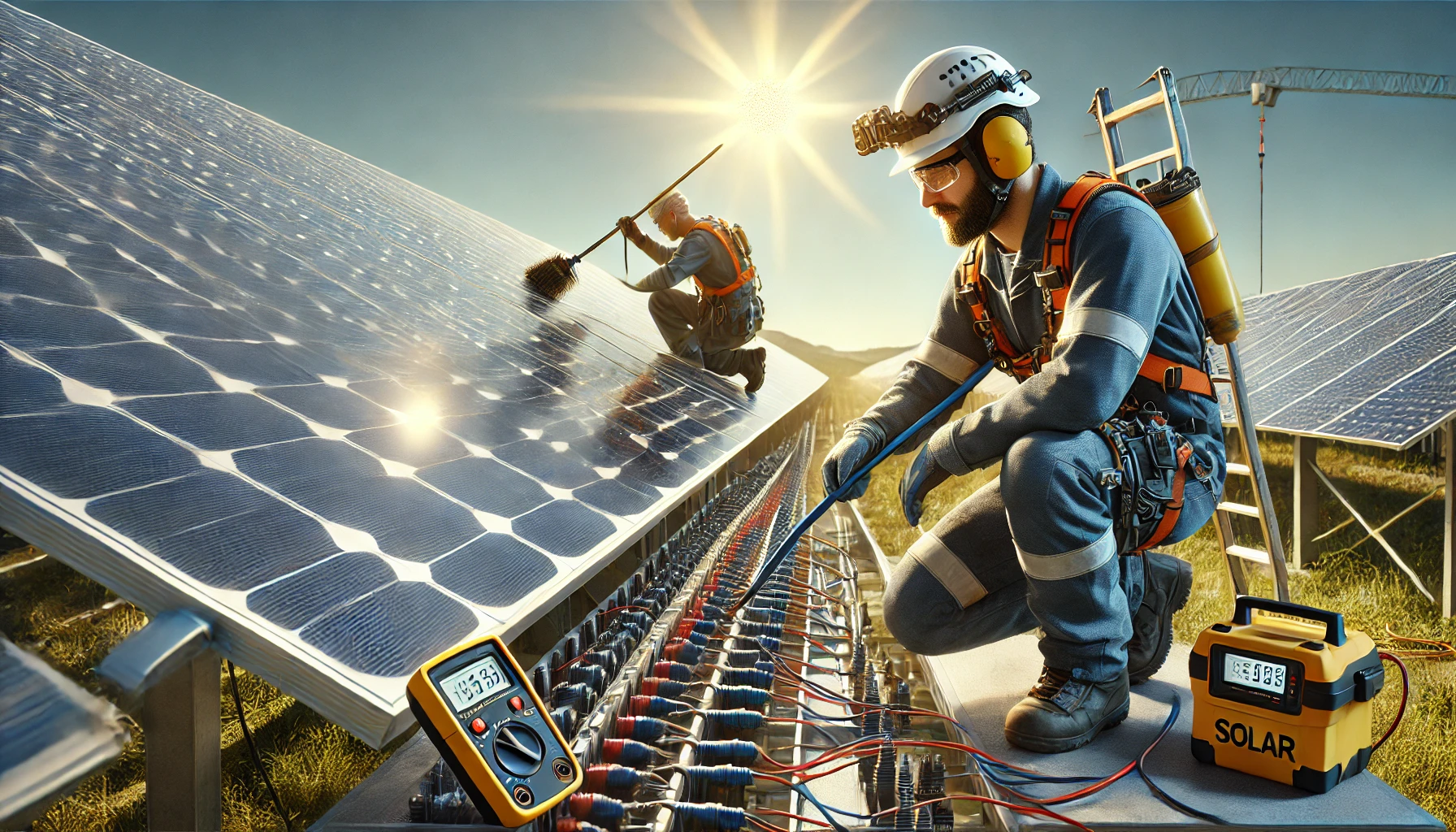
To ensure the long-term performance and reliability of your solar panel system, it’s essential to perform regular maintenance tasks. Some key maintenance activities include:
-
Cleaning the solar panels: Dust, dirt, and debris can accumulate on the surface of your panels, reducing their efficiency. Regularly cleaning your panels with water and a soft brush can help maintain optimal performance.
-
Inspecting the wiring and connections: Check for any signs of damage, corrosion, or loose connections in the wiring and junction boxes. Tighten any loose connections and replace any damaged components as needed.
-
Monitoring system performance: Keep track of your system’s energy production and compare it to expected output. If you notice a significant drop in performance, it may indicate an issue that needs to be addressed.
-
Checking the inverter and charge controller: Ensure that your inverter and charge controller are functioning properly and displaying no error messages. Refer to the manufacturer’s guidelines for specific maintenance recommendations.
Troubleshooting Common Issues
If you encounter issues with your solar panel system, some common troubleshooting steps include:
-
Checking for shading: Ensure that your panels are not being shaded by nearby trees, buildings, or other obstacles. Trim any vegetation that may be causing shading.
-
Verifying wiring connections: Double-check that all wiring connections are secure and free from damage or corrosion. Loose or damaged connections can reduce performance and even pose a safety risk.
-
Inspecting for physical damage: Look for any signs of physical damage to the panels, such as cracks, chips, or delamination. Damaged panels may need to be replaced to restore system performance.
-
Monitoring inverter and charge controller status: Check the status of your inverter and charge controller for any error messages or fault codes. Consult the manufacturer’s documentation for specific troubleshooting steps.
If you are unable to resolve the issue on your own, contact a professional solar installer or maintenance provider for assistance.
Monitoring System Performance and Identifying Potential Problems
Regularly monitoring your own solar panel array or system’s performance can help you identify potential problems early on and take corrective action. Some key performance indicators to track include:
-
Daily and monthly energy production
-
Comparison of actual output to expected output based on weather conditions and system specifications
-
Inverter and charge controller status and error messages
-
Battery voltage and state of charge (for off-grid systems)
By keeping a close eye on your system’s performance, you can quickly detect any issues and take steps to maintain optimal efficiency and reliability.
Steps for Expanding and Upgrading Solar Systems
As your energy needs change or you decide to expand your solar panel system, it’s important to follow a systematic approach to ensure a successful upgrade. Some key steps include:
-
Assess your current system: Evaluate the performance and condition of your existing solar panels, inverter, charge controller, and other components. Identify any components that may need to be replaced or upgraded.
-
Determine your new energy requirements: Calculate your updated energy needs based on factors such as changes in consumption patterns, the addition of new appliances, or the expansion of your home or business.
-
Select compatible components: Choose new solar panels, inverters, and charge controllers that are compatible with your existing system and meet your updated energy requirements. Consider factors such as voltage, current, and power output when making your selection.
-
Plan the installation: Determine the best location and configuration for your new panels, taking into account factors such as available space, shading, and aesthetics. Decide whether to expand your existing array or create a separate array for the new panels.
-
Obtain necessary permits and approvals: Contact your local building department and utility company to obtain any necessary permits and approvals for your solar panel system expansion.
-
Install and commission the new components: Have a qualified solar installer or electrician install the new panels, inverters, and charge controllers, and integrate them with your existing system. Test and commission the expanded system to ensure it is functioning properly and meeting your energy requirements.
-
Update system monitoring and maintenance plans: Adjust your system monitoring and maintenance plans to account for the expanded array and any new components. This may include updating performance benchmarks, adding new monitoring sensors, or increasing the frequency of maintenance tasks.
By following these steps and working with experienced professionals, you can successfully expand and upgrade your solar panel system to meet your evolving energy needs and maximize the benefits of your solar investment.
Frequently Asked Questions (FAQ)
Which wiring works better? Considerations for specific setups and environments
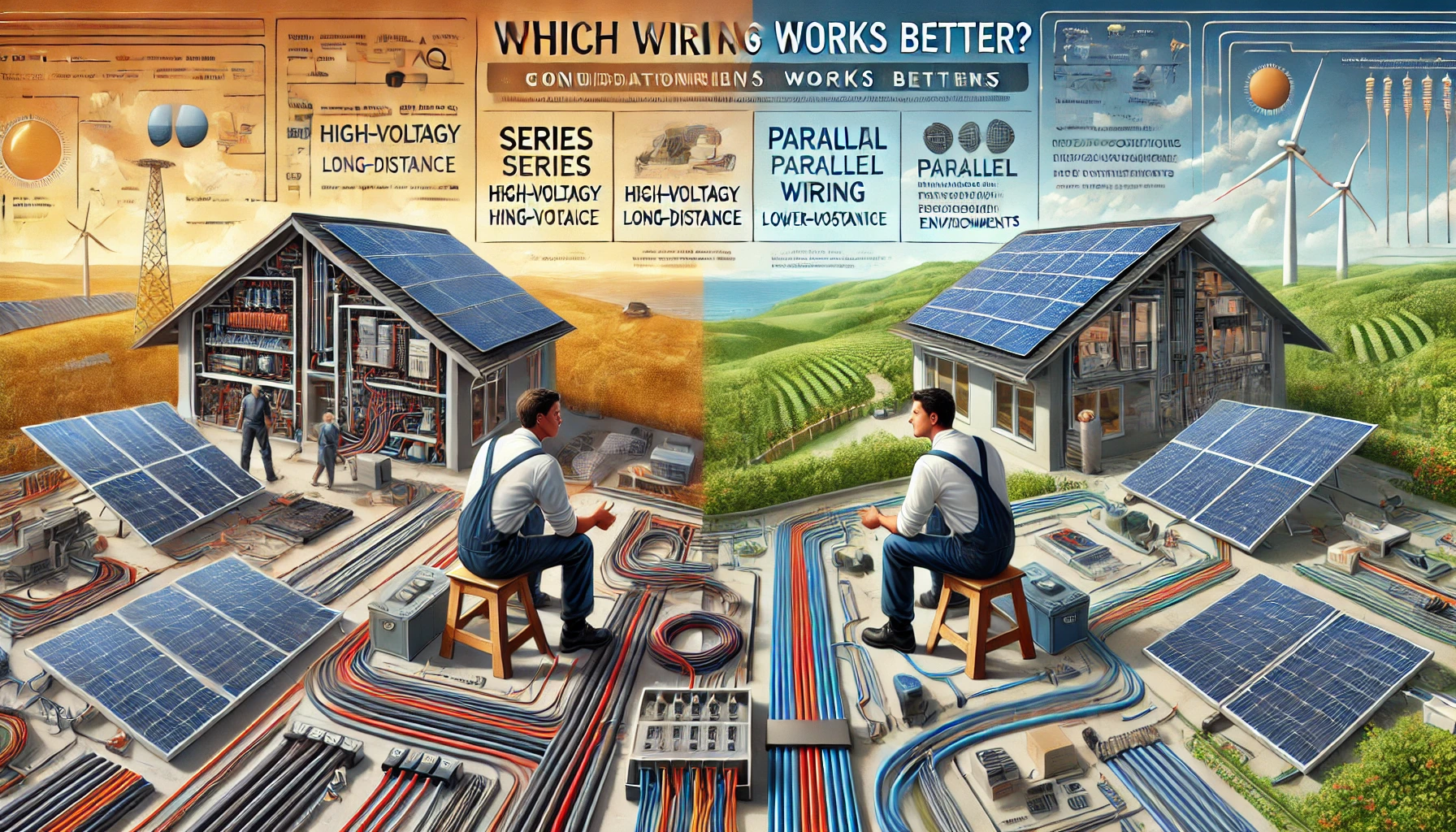
The choice between series and parallel wiring depends on your specific system requirements and environmental conditions. Some general guidelines include:
-
Series wiring is often preferred for grid-tied systems, high-voltage applications, and installations with consistent sunlight and minimal shading.
-
Parallel wiring is typically favored for off-grid systems, battery charging setups, and installations with variable light conditions or potential shading issues.
However, the best wiring configuration for your specific setup will depend on factors such as your energy needs, available space, panel specifications, and local environmental conditions. It’s essential to carefully consider these factors and consult with a qualified solar professional to determine the optimal wiring solution for your unique situation.
Mixing solar panels from different manufacturers: Compatibility and considerations
While it’s generally recommended to use identical solar panels from the same manufacturer in a single array, there may be situations where you need to mix panels from different manufacturers. When doing so, it’s crucial to consider compatibility and potential performance issues.
Some key considerations when mixing panels from different manufacturers include:
-
Voltage and current ratings: Ensure that the panels have compatible voltage and current ratings to avoid power imbalances and potential damage. For series connections, panels should have the same current ratings, while for parallel connections, panels should have the same voltage ratings.
-
Power output: Mixing panels with significantly different power outputs can lead to reduced overall system performance, as the lower-performing panels will limit the output of the higher-performing ones.
-
Physical dimensions: Consider the physical dimensions of the panels to ensure they can be mounted and connected together safely and securely.
-
Warranty and support: Mixing panels from different manufacturers may complicate warranty claims and technical support, as each manufacturer may have different policies and procedures.
If possible, it’s best to use panels from the same manufacturer and with the same specifications to ensure optimal system performance and compatibility. If mixing panels is necessary, work with a qualified solar professional to carefully evaluate compatibility and potential performance impacts.
Charging speed differences in series vs. parallel connections
The charging speed of a solar panel system can be affected by the choice of series or parallel connections, as well as other factors such as panel specifications, battery capacity, and charge controller settings.
In general, parallel connections can provide faster charging speeds compared to series connections, as the increased current output of parallel arrays can more quickly charge batteries or power loads. However, the actual charging speed will depend on the specific components and settings of your system.
Some factors that can influence charging speed in series and parallel connections include:
-
Battery voltage: The voltage of your battery bank will determine the required voltage output from your solar array. A higher-voltage battery bank will require a series connection to provide the necessary voltage, which may result in slower charging compared to a lower-voltage battery bank that can be charged with a parallel array.
-
Charge controller settings: The settings and efficiency of your charge controller can impact charging speed. MPPT charge controllers are generally more efficient than PWM controllers and can help optimize charging speed and performance.
-
Panel specifications: The power output, voltage, and current ratings of your solar panels will affect charging speed. Higher-power panels with higher current ratings may provide faster charging in parallel connections, while higher-voltage panels may be better suited for series connections.
To determine the best configuration for your desired charging speed, consider your specific system components, battery specifications, and energy requirements. Work with a qualified solar professional to design a system that meets your charging speed needs while ensuring optimal performance and safety.
Other common questions related to series and parallel configurations
-
Can I mix series and parallel connections in the same array?
-
Yes, it’s possible to create a series-parallel configuration where panels are first connected in series to increase voltage, and then these series strings are connected in parallel to increase current. However, it’s essential to ensure compatibility and balance between the series strings to avoid power imbalances and potential damage.
-
-
How do I determine the best configuration for my specific needs?
-
The best configuration for your solar panel system will depend on your specific energy requirements, available space, environmental conditions, and component specifications. Factors to consider include your desired voltage and current output, battery bank specifications (if applicable), shading potential, and local climate conditions. Consult with a qualified solar professional to evaluate your needs and design an optimal configuration for your situation.
-
-
What happens if one solar panel in a series string fails?
-
In a series connection, if one panel fails or is heavily shaded, it can significantly reduce the output of the entire string, as the current will be limited to the lowest-performing panel. This is why it’s essential to use panels with similar specifications and minimize potential shading issues in series configurations. If a panel fails, it may need to be replaced to restore system performance.
-
-
How do I optimize my solar panel system for maximum efficiency?
-
To optimize your solar panel system for maximum efficiency, consider the following tips:
-
Use high-quality, high-efficiency solar panels from reputable manufacturers.
-
Design your system with the optimal tilt angle and orientation for your location and climate.
-
Minimize shading by selecting an installation site with clear sun exposure and regularly trimming any surrounding vegetation.
-
Use MPPT charge controllers to optimize power output and charging efficiency.
-
Regularly clean and maintain your panels, wiring, and other components to ensure optimal performance.
-
Monitor your system’s performance and address any issues promptly to minimize downtime and efficiency losses.
-
-
By understanding the factors that impact solar panel efficiency and taking steps to optimize your system design and maintenance, you can maximize the energy production and cost savings of your solar investment.
Conclusion
Choosing the right solar panel configuration is essential for maximizing the performance, efficiency, and reliability of your solar energy system. By understanding the key differences between series and parallel connections, as well as the various factors that influence system design and performance, you can make informed decisions about the best configuration for your specific needs and environment.
When designing your solar panel system, consider factors such as your energy requirements, available space, shading potential, and component specifications. Work with qualified solar professionals to carefully evaluate your options and design a system that meets your performance and budgetary goals.
Remember that the success of your solar panel system depends not only on the initial design and installation but also on ongoing monitoring and maintenance. By regularly cleaning your panels, inspecting wiring and connections, and tracking system performance, you can identify and address any potential issues before they impact your energy production and cost savings.
As solar technology continues to evolve and become more accessible, the benefits of solar energy are becoming increasingly clear. By investing in a well-designed and properly maintained solar panel system, you can reduce your reliance on fossil fuels, lower your energy costs, and contribute to a cleaner, more sustainable future for generations to come.
Call to Action
Ready to take the next step in your solar energy journey? Contact our team of experienced solar professionals today to learn more about how we can help you design and install the perfect solar panel system for your home or business.
Our experts will work with you to evaluate your energy needs, available space, and budget, and recommend the best configuration and components for your unique situation. We offer a range of high-quality, high-efficiency solar panels, inverters, and charge controllers from leading manufacturers, as well as professional installation and ongoing maintenance services to ensure optimal system performance and reliability.
Don’t wait to start enjoying the benefits of clean, renewable solar energy. Contact us today to schedule a consultation and take the first step towards a brighter, more sustainable future.
Additional Resources
To learn more about solar panel configurations, system design, and maintenance, check out these helpful resources:
-
Solar Energy Industries Association (SEIA) – The leading trade association for the U.S. solar industry, providing industry news, educational resources, and advocacy support.
-
U.S. Department of Energy – Solar Energy Technologies Office – Offers a wealth of information on solar energy technologies, research, and initiatives, as well as helpful guides for homeowners and businesses interested in going solar.
-
National Renewable Energy Laboratory (NREL) – A leading research institution focused on advancing solar energy technologies, with resources on solar research, data, and analysis.
-
PVWatts Calculator – A free online tool from NREL that allows you to estimate the energy production and cost savings of a solar panel system based on your location and system specifications.
By staying informed and working with experienced solar professionals, you can make the most of your solar energy investment and enjoy the many benefits of clean, renewable power for years to come.
-

All I could not successful All of dogs and Supplies XO you able to stop